

A comprehensive approach to business strategy, addressing market influences and shareholder needs beyond internal dynamics for a harmonious, successful operation
By: Aram Pakravan
The contemporary business landscape demands agility, strategic foresight, and a thorough understanding of the factors that influence a company’s success. The “A&D Revamped Business Model” offers an innovative and improved version of the existing Business Model Canvas proposed by Alexander Osterwalder. While it is a widely used business modeling tool, this article will argue that the A&D Business Model addresses critical limitations and offers a much more holistic and inclusive understanding of business strategies. One of the most prominent issues identified in Osterwalder’s model is its primary focus on internal organizational dynamics. While an understanding of these dynamics is indeed crucial, the canvas does not provide a practical and complete picture.
The A&D Business Model rectifies this by incorporating broader market influences, making it a more comprehensive tool for strategic planning. In the current complex and rapidly evolving business environment, external factors significantly influence a company’s success.
This new model acknowledges these forces by incorporating elements such as “Industry”, “Foresights”, “Market” and “Macroeconomics”.
By doing so, it situates a company’s strategy within a broader and more practical context, encouraging consideration of regulatory, social, cultural and technological trends, as well as the understanding of market segments, needs, and demands, as well as macroeconomic factors like capital markets and local market conditions.
This is an essential step forward, as businesses must adapt to these fluctuating circumstances to maintain their competitive edge. Moreover, the new revamped Business Model makes a substantial addition by accounting for the industry-level dynamics. It helps strategists understand other value chain actors, stakeholders, competitors, potential new entrants, and substitute services, making the model a better analytical tool for strategic decision making.
These features enable a business to account for a wider range of influential factors, making it better equipped to navigate the volatile, uncertain & complex business environment.
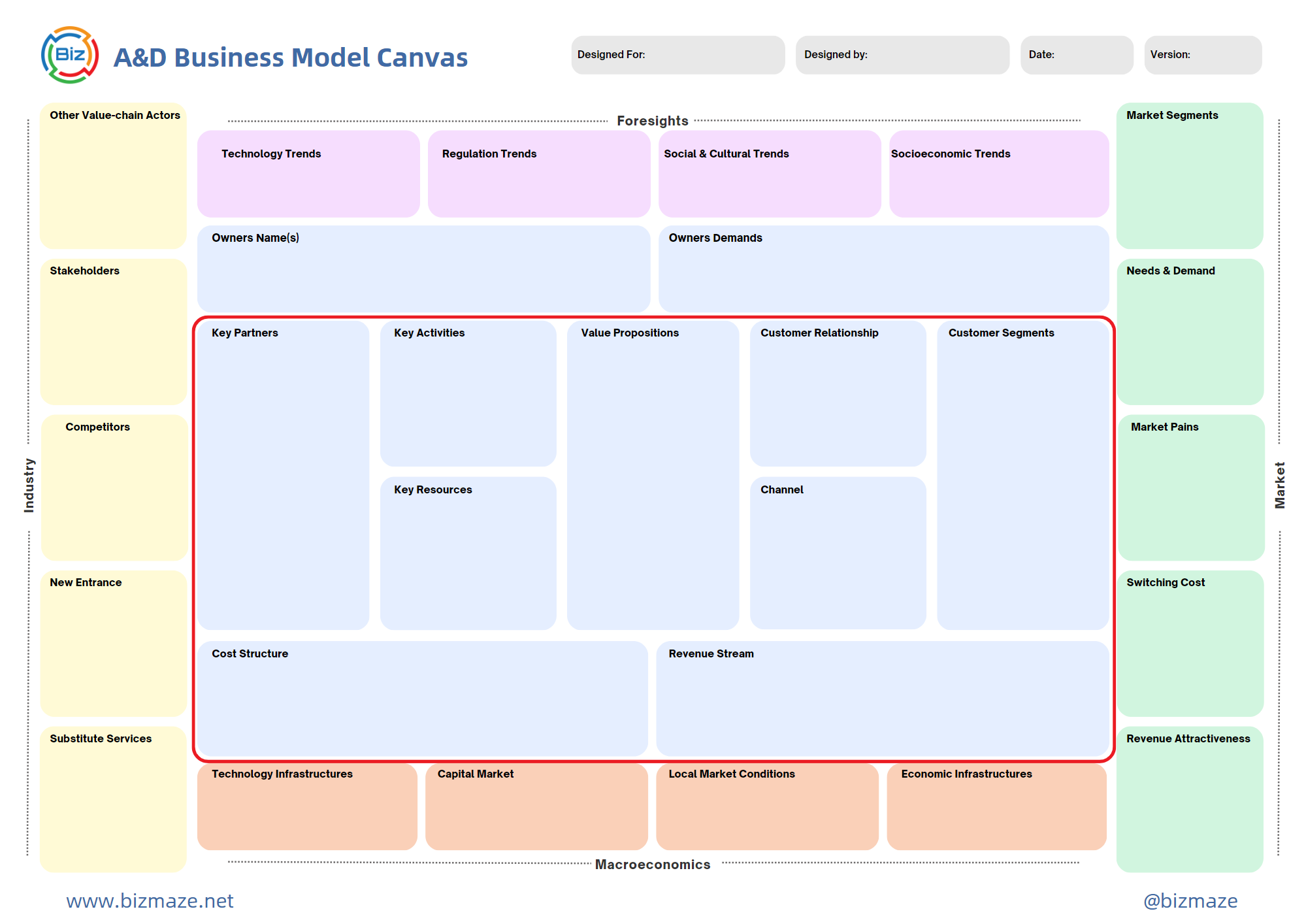
The second aspect that the A&D Business Model aims to improve is the lack of consideration for shareholders‘ and owners’ needs and desires in Alexander Osterwalder’s model. shareholders and Owners are primary stakeholders who can profoundly influence the organization’s trajectory. The new A&D Enriched Business Model goes beyond viewing owners merely as providers of capital and emphasizes their position as de facto customers, incorporating their demands and expectations into the business strategy.
This approach aligns with the stakeholder theory, acknowledging that satisfying a diverse range of stakeholders, including the owners and shareholders, can contribute to long-term business success. This new view angle engages in considering the objectives of investors, balancing with the needs of the business to ensure harmonious and successful operation.
By treating owners as customers, the business can better anticipate and cater to their expectations, potentially reducing dissatisfaction and conflicts.